Publications
Augmented und Virtual Reality
Josef Buchner, Markus Tatzgern, Ines Deibl, Miriam Mulders
Digitale Medienbildung: Pädagogik-Didaktik-Fachdidaktik, 2023
Trotz der technologischen Reife von Augmented Reality (AR) und Virtual Reality (VR) und der breiten Verfügbarkeit von AR/VR-Anwendungen ist deren Verwendung im Schulunterricht noch eher die Ausnahme. Dieses Buchkapitel zeigt Potenziale für den Einsatz von AR/VR im Unterricht auf, um die Nutzung dieser Technologien im Unterricht zu inspirieren und Hemmschwellen abzubauen. Die erarbeitete Umsetzungshilfe für AR/VR im Unterricht basiert dabei auf den Möglichkeiten aktueller Technologien bzw. dem Stand der aktuellen didaktischen Forschung. Statt bestehende Unterrichtsmethoden zu ersetzen, hat die Umsetzungshilfe das Ziel, AR/VR als Ergänzung und Unterstützung von bestehenden Lerninhalten in den Unterricht zu integrieren.
Effekte von Prompting beim Augmented Learning im Sachunterricht der Primarstufe
A. Anzengruber, T. Fleischer, J. Zumbach
GDCP-Jahrestagung 2023, Hamburg, Deutschland, 2023
Augmented Learning Lab – eine hybride Lernumgebung für innovativen Sachunterricht
M.C. Fritz, C. Egger, T. Fleischer, D. Zezula, M.Tatzgern, M. Wolf, G. Wagner, S. Fink, H. Neureiter
Jahrestagung der Gesellschaft für Didaktik des Sachunterrichts (GDSU) 2023, Pädagogische Hochschule Salzburg (AUT), 2023
Zentrifugieren und Homogenisieren im Sachunterricht
M.C. Fritz, C. Egger, H. Neureiter, T. Fleischer
GDCP-Jahrestagung 2023, Hamburg, Deutschland, 2023
Exploring Input Approximations for Control Panels in Virtual Reality
Markus Tatzgern, Christoph Birgmann
2021 IEEE Virtual Reality and 3D User Interfaces (VR), 2021
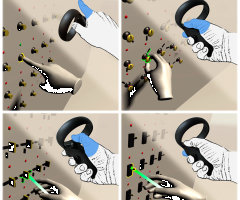
Today's availability of sophisticated consumer-grade Virtual Reality (VR) hardware provides affordable access to training simulation technology. In contrast to more traditional high fidelity training simulations utilizing physical replicas of control panels that allow natural interaction, users of virtual training often rely on handheld VR controllers to manipulate simulated controls. Therefore, control manipulations of virtual buttons and sliders must be mapped to approximations of real hand manipulations. For instance, the turning of a physical knob with thumb and index finger can be mapped to a gross motor forearm rotation, or a fine motor joystick manipulation when manipulating a controller. In this paper, we present an exploration of hand input approximations of real hands to manipulate the buttons, toggles, knobs and sliders using typical handheld VR controllers. We use common Oculus Quest controllers that rely on capacitive sensing to create basic, approximate hand gestures. We demonstrate the potential of our designs by performing an experiment in which we compare approximate hand gestures against using the controller's joystick that allows fine motor control using thumb input, and a baseline ray-casting interaction that is commonly used in VR applications. We provide a detailed analysis of our interaction designs using the Framework for Interactive Fidelity Analysis (FIFA), which allows us to discuss differences between input approximations and the real-world hand manipulations.